

Think of emergencies when parking
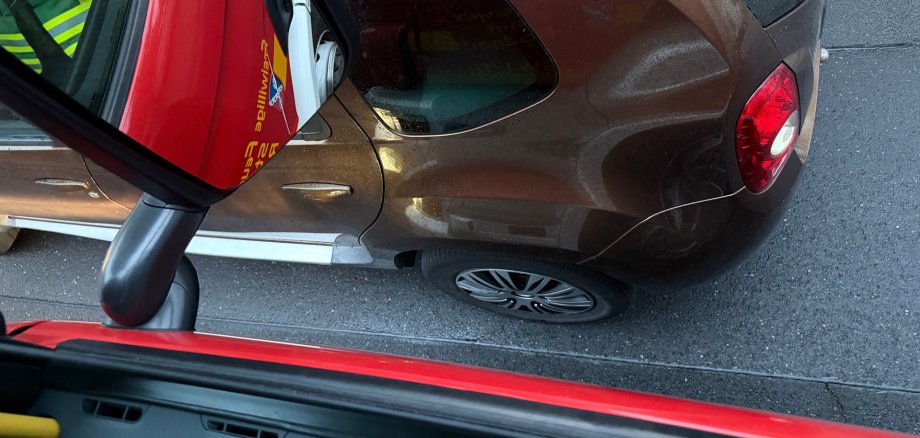
It doesn’t take long to park a car – but in an emergency, choosing the wrong spot can mean the difference between life and death. To draw attention to the increasing congestion caused by inconsiderate parking, Mayor Max Breitenbach, Deputy Mayor Janika Martin, Head of the Public Safety and Order Department Gregor Fanroth and City Fire Inspector Christian Hinrichs, together with members of the fire brigade, carried out a large-scale traffic flow test in the Rodgau town centre.
Fire engine test
The fire brigade’s largest fire engines were deployed to cover specific critical sections of road. “Our fire brigade always reaches its destination – that’s the good news,” sums up Mayor Max Breitenbach. “But the ‘how’ is the problem. Often, these large vehicles, weighing several tonnes, have to be manoeuvred past cars centimetre by centimetre or painstakingly guided by emergency personnel. This costs valuable seconds or even minutes, which can be crucial in an emergency.” Even though information leaflets were handed out, the campaign was not intended to issue fines indiscriminately, but to raise clear awareness amongst the public. “Many motorists do not park illegally out of malice, but because they are unaware of the dimensions of a modern fire engine.”
Social distancing rules
“The test run shows that the distance regulations in the STVO are sensible and necessary to ensure accessibility at all times,” Mayor Breitenbach goes on to explain. The emergency vehicles used for the test run are around 2.50 metres wide, including wing mirrors, and up to 10 metres long. Where a normal car can still pass through without any problems, it is often impossible for emergency services vehicles – and for refuse collection lorries – to do so. Firefighter Cedric Völker summed it up during the test drive along Landwehrstraße in Jügesheim: “Two weeks ago, I drove through here – we even took a photo of it – and there was a vehicle still half on the road: it was impossible to get through.” The Public Order Office and the Rodgau Fire Brigade are therefore strongly reminding the public of the applicable rules of the Road Traffic Regulations (StVO), with a particular focus on three areas: where parking is permitted on both sides of the road, a minimum clear carriageway width of 3.05 metres must remain free for through traffic. This is the only way emergency and fire engines can pass through the street without delay. If, on the other hand, vehicles are parked on opposite sides in a staggered formation, the street quickly becomes a slalom course. A minimum distance of 10 metres should therefore be maintained between cars parked in a staggered formation, so that long fire engines can manoeuvre through without time-consuming manoeuvring. The situation is often particularly critical on tight bends, as well as at junctions and road junctions, where parking is prohibited anyway. Here, a distance of at least 5 metres must be maintained from the points where the kerbs meet – if there is a structurally built cycle path to the right of this, this distance increases to 8 metres. Larger emergency vehicles have an enormous turning circle and absolutely require this space for manoeuvring. Furthermore, there is a strict ban on parking in front of and opposite property entrances and exits if the carriageway is too narrow – as a guideline, where less than 5.50 metres of remaining width is available or where there are lowered kerbs.
Double-parking and a roll call
Whilst double-parking is prohibited without exception, parking on the pavement is also generally prohibited, unless signs or road markings expressly permit it. Last but not least, a distance of up to 15 metres must be maintained in front of and behind bus stop signs, as parking and stopping are generally prohibited on blind or very narrow stretches of road. Deputy Mayor Janika Martin has announced that, as part of traffic enforcement, such checks within the town will be stepped up in future. “We appeal to the solidarity of all Rodgau residents. After parking, always take a quick look behind you: if in doubt, could a large lorry still fit through here? Please keep emergency routes clear – in an emergency, your own safety could be at stake.”