
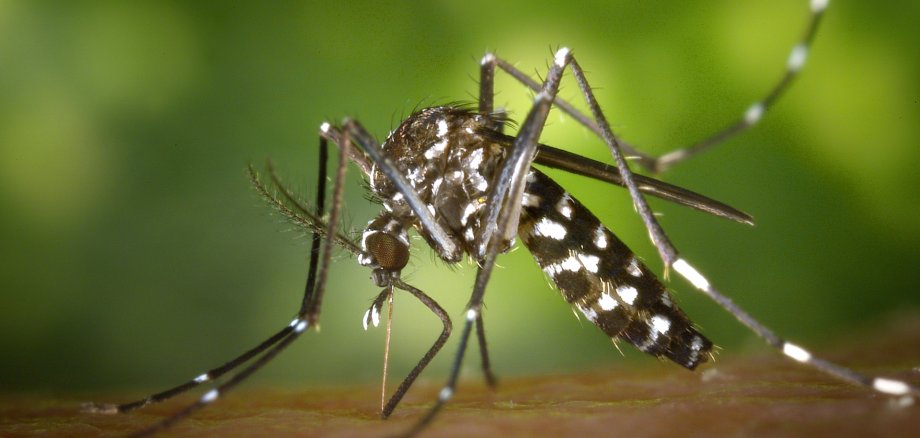
The Asian tiger mosquito has arrived in Rodgau. The town is informing residents about its characteristics, behaviour and the necessary protective measures. The tiger mosquito measures between 0.5 and 1 centimetre in length and has a deep black body with striking white stripes. The head and dorsal region of the thorax feature a white or silver longitudinal stripe. Its hind legs have five rings, with the last segment being entirely white. The tiger mosquito is active during the day and can bite. Its bite is no more dangerous than that of native mosquitoes and usually causes swelling and itching. The mosquito can transmit diseases such as dengue, chikungunya, West Nile virus, Zika or yellow fever. However, these pathogens are not present in the mosquito itself, but must be transmitted via infected humans. No transmission by the Asian tiger mosquito has been documented in Hesse to date; the risk is considered low. To curb its spread, small pools of standing water should be regularly removed or turned upside down. These include watering cans, flower pot saucers, toys and old tyres. Paddling pools and bird baths should be cleaned regularly and the water changed. Rainwater barrels can be covered with fine mosquito netting. Sightings of the Asian tiger mosquito can be reported online at mueckenatlas.com. Sightings are investigated there and published on a map. Further information is available at hlfgp.hessen.de/klimawandel-und-gesundheit/asiatische-tigermuecke. If you have any questions, please contact the Offenbach District Health Authority or Dr Katrin Steul and Ms Maraslioglu.