

Meter reading campaign launched
The year is slowly drawing to a close, and with it, the billing of water and sewerage charges by Stadtwerke Rodgau in the districts of Weiskirchen, Hainhausen, Jügesheim and Dudenhofen is fast approaching. This year’s meter reading campaign began on Friday, 20 November. As part of this, Stadtwerke Rodgau is sending emails to all properties whose residents consented to the use of their email address during last year’s meter reading. Residents can simply submit their meter readings online via a link included in the email. The data is, of course, transmitted in encrypted form.
Tickets with a QR code
Anyone who has not submitted their meter reading online by Sunday 29 November, as well as all those residents who have not expressly consented to the use of their email address, will receive their meter reading card by post from Monday 30 November. As in the previous year, the meter reading cards feature a QR code. By scanning the QR code, you can conveniently submit your current meter reading until 31 December.
Non-digital alternative
Alternatively, you can return the meter reading cards postage-free. Of course, throughout the entire meter reading campaign, you can also submit your meter readings as usual by email to kundenservice@stadtwerke-rodgau.de or by telephone on 06106 8296-0. All meter readings should be submitted by 31 December.
Private garden or wastewater meters
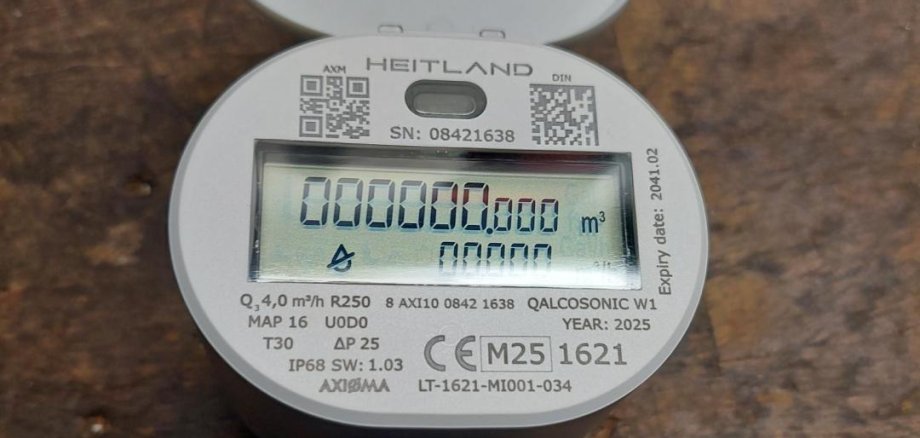
Meter readings from private garden or waste water meters must also be reported to the municipal utilities. This can be done easily via our online service at https://qr.de/Zaehlerstand. Meter readings submitted after the end of the year will not be taken into account for the annual consumption bill and will, in this case, be estimated automatically. As part of the switch to wireless water meters, around 80 per cent of the main water meters have already been replaced with wireless water meters. Remote reading of the wireless water meters will take place on 31 December 2026.
Info
Since 2022, Stadtwerke Rodgau has been replacing analogue water meters due for routine replacement in the supply area covering Weiskirchen, Hainhausen, Jügesheim and Dudenhofen with wireless water meters. This approach saves resources, as the analogue meters are only replaced when their calibration period expires, and the effort involved is equivalent to the previous scheduled replacement programme. To date, around 80 per cent of the main water meters have been replaced with wireless water meters in this way. The plan is to have converted all remaining analogue water meters to wireless water meters by the end of 2027.