
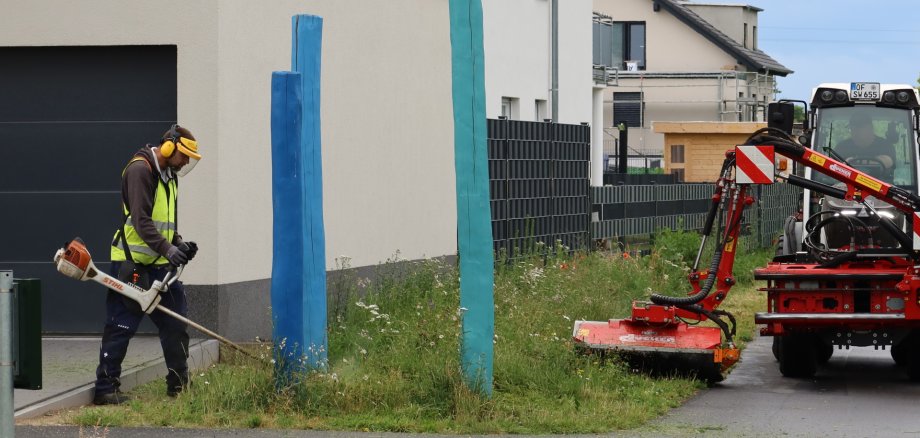
The garden at home is tended, maintained, mowed, watered and occasionally redesigned. Depending on its size, the amount of work involved can be manageable or enormous. A 19-strong team from the Rodgau Municipal Works maintenance depot looks after a ‘garden’ covering around 741,000 square metres. This includes the well-known public green spaces within the town, maintenance of the Roda river, sports fields, bridge approaches and embankments, as well as the upkeep of playgrounds. But that’s not all, as cemeteries, ditches, stormwater overflow basins, infiltration basins and the grounds of the sewage treatment plant also fall under the remit of green space maintenance. That, incidentally, adds up to a further 214,000 square metres. New areas are constantly being added. For instance, further perennials and solitary plants have been planted at the registry office, unpaved traffic islands have been greened, and flowerbeds have been redesigned as part of the district-wide ‘Vergissmeinnicht’ campaign. When selecting plants, attention is paid not only to heat and drought resistance but also to the level of maintenance required. The plants are intended not only to be biodiverse and ‘useful’ for bees and insects throughout the year, but also to please the human eye. Dry grasses also have an ornamental effect in winter, and road safety – in particular visibility on the roads – is, of course, also taken into account. Whereas maintenance was largely carried out by external specialist firms in the past, since 2020 the city has been consciously pursuing the goal of gradually transferring these tasks more firmly into municipal responsibility. The aim is to achieve greater flexibility in green space maintenance. This enables the team to respond more quickly to different growth phases or weather conditions and to adapt maintenance operations flexibly to current requirements within the urban area. In parallel with the transfer of maintenance services, the staffing levels at the municipal works yard have been gradually adjusted to the increased scope of tasks. Through additional recruitment, targeted internal training initiatives and the training of its own gardeners since 2022, the municipal works department has been able to significantly increase its capacity. It is now able to carry out the tasks it has taken on to a high professional standard. Another key factor in improving efficiency was the targeted procurement of modern machinery and tools. Examples include the retrofitting of an existing vehicle with a weed brush and a hedge trimmer with a mulching function. These investments have enabled work processes to be optimised and maintenance work to be carried out more cost-effectively. At the same time, this ensures the quality of maintenance in the long term. By consolidating tasks within the municipal structure, synergy effects are created in terms of resource planning, the use of machinery and equipment, and the coordination of work processes. And this applies not only in summer, but also during the winter months. The machinery can be converted and existing staff deployed when a rapid response to snow or icy conditions is required. To date, the results have been positive. Having both staff and machinery under one roof means being able to carry out tasks in a technically sound, organisationally efficient and economically viable manner. This makes the Rodgau Municipal Works depot an important component of the urban fabric and part of the foundation for a well-maintained, attractive and liveable environment for the people of Rodgau.