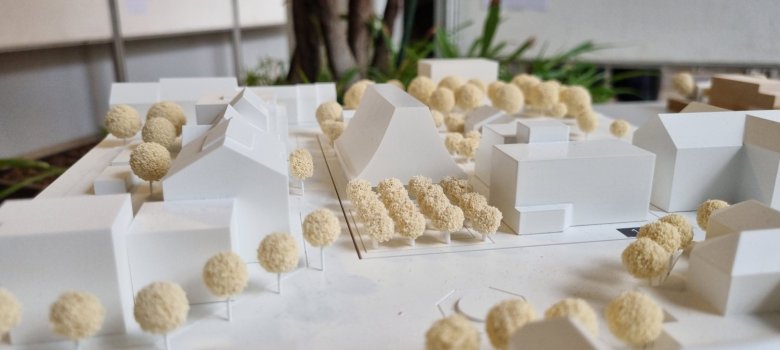

New Nieder-Roden district centre
As part of the "Zuhause im Zentrum" funding programme, holding a competition to plan the construction of the new social centre was a key component. The aim of the interdisciplinary competition was to obtain creative designs for the future use of the social centre that would serve as the basis for its subsequent realisation.
The aim is to create a hybrid building that is
- characterised by a diverse mix of uses
- appeals to all population and age groups
- incorporates and revitalises the square in front of it as an experience space
The room concept
In an intensive planning process, a new spatial concept was developed that takes into account the future requirements of the neighbourhood. The plans include
- an enlarged and family-friendly library
- larger exhibition areas
- User workstations and rooms
- Areas for children and young people
- Flexible use of space for adult education centre events, clubs, initiatives and projects
- three larger multifunctional rooms
- Additional group rooms
- a new youth centre
The competition
The competition was officially launched in early summer and met with great interest. Numerous architectural firms from all over Germany applied to take part. From May to August, the competition participants had time to draw up plans and models. A total of 13 entries were submitted. An interdisciplinary jury scrutinised, discussed and evaluated all entries in detail. A total of three prizes and two commendations were awarded.
The results of the realisation competition were then presented in a public exhibition. There, citizens were able to gain an impression of what the new district centre at Puiseauxplatz in Nieder-Roden could look like in the future and what architectural approaches the participating offices are pursuing.
The award winners
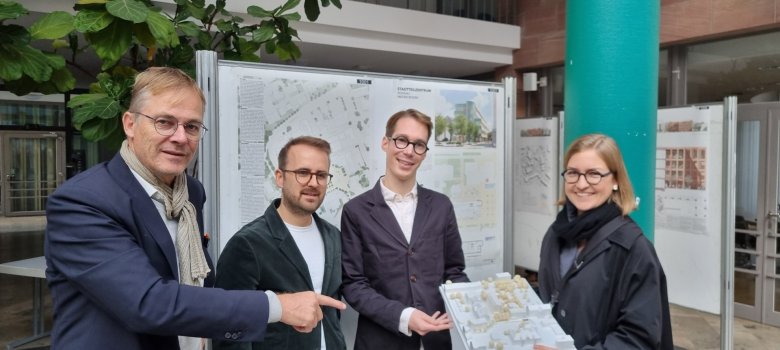
1st prize: Büro ROHWAREIMSTUDIO, Munich
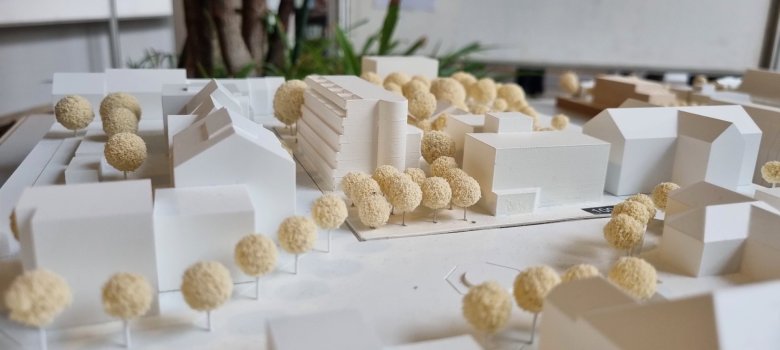
First prize went to ROHWAREIMSTUDIO from Munich. The design impressed the jury with its modern yet functional design. The building blends in well with its surroundings and successfully combines interior and exterior spaces. The existing plane tree grove is largely preserved. The building blends in with the neighbouring buildings. The gable end with the clearly visible staircase is particularly striking and gives the building a clear recognition value.
On the ground floor, there are interconnecting multifunctional rooms and an open foyer that opens up to a covered outdoor area that enlivens the square in front of it. The youth area is planned separately as a kind of "garden pavilion". The internal organisation allows different areas to be used independently of each other. A warm-up kitchen and toilets can be used for parties, for example. Course rooms and offices are located on the first floor. The library extends over a total of three floors. Stepped recesses create attractive terraces for outdoor reading.
The utilisation concept is versatile: it offers rooms for events, educational programmes and social work that can be flexibly adapted. The orientation in the building is clear and all areas are barrier-free. The compact design, robust materials such as wood and clay and energy-efficient planning ensure sustainability and low operating costs over the entire life cycle.
2nd prize: Büro Hascher Jehle, Berlin
The design by Hascher Jehle complements the existing buildings in a convincing manner and blends in well with the surroundings thanks to its building heights. The spatial concept is coherent overall and sensibly realises the required uses. The ground floor is logically structured and is well connected to the neighbouring open spaces. However, the placement of individual rooms on the ground floor and basement was critically scrutinised.
The open-plan foyer opens generously onto the square and creates an inviting entrance area. The jury also particularly appreciated the location of the youth area with the associated outdoor spaces. The administration rooms on the upper floor are clearly organised and compact. The library is spread over two and a half floors, connected by a striking circular staircase.
The exterior design appears robust and coherent, while the interior design should be further developed. The project appears to be economically feasible in principle, but has a higher estimated carbon footprint compared to the other designs.
3rd prize: Sturm and Wartzeck office, Dipperz
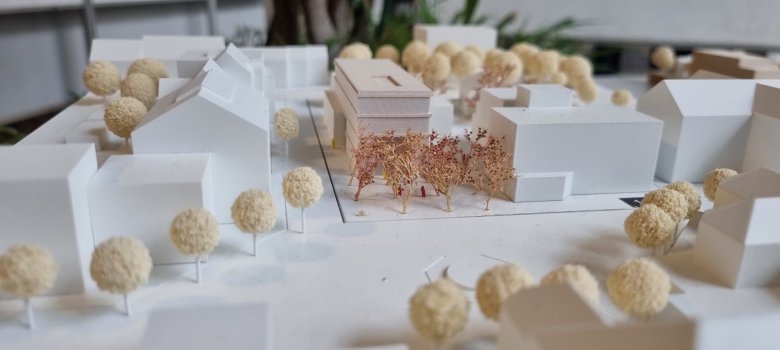
Sturm und Wartzeck were awarded third prize. The design impresses with a striking structure that clearly organises the square and the passageways, itself acting as a defining element of the urban space and connecting it with one another. The flooring extends invitingly from the square into the ground floor. This can be used in a variety of ways and has a close functional relationship to the neighbouring areas. The existing plane tree grove on Puiseauxplatz is retained and forms a natural "canopy" for the district centre.
The ground floor is clearly laid out, although the staircases arranged along the façades make orientation difficult at times. A flexibly usable area, which can be connected to the foyer, forms a central meeting point between the urban community and the district centre. The main entrance is located on the gable end facing the square, from where the staircase and lift provide access to the upper floors.
The multifunctional area is clearly structured on the first floor, while the library extends over the narrower storeys above. It impresses with its good lighting and the reading area with a large window overlooking Puiseauxplatz, which creates a special spatial atmosphere.
The design is basically easy to realise. The façade made of prefabricated timber frame elements and perforated aluminium sheet is an exciting approach, but one that still needs to be critically examined in terms of practical implementation.