
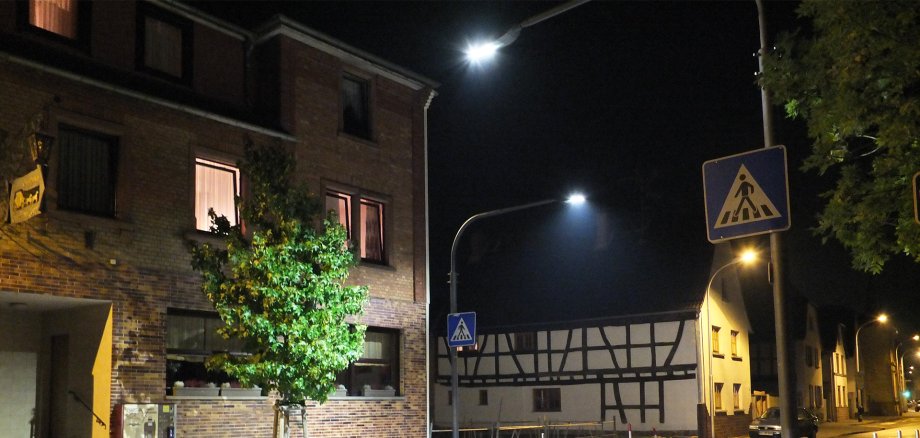
1,000 street lights were converted to LED technology throughout the city, including new control technology. The city of Rodgau is thus implementing the funding measure "Climate protection projects in the municipal environment" as part of the municipal guideline of the Federal Ministry for Economic Affairs and Climate Protection in the funding area of outdoor and street lighting controlled according to time and presence. The city of Rodgau is receiving a grant from the Federal Climate and Transformation Fund for the project. The funding rate is 25 per cent. Funding will be provided for system components of lighting systems for traffic areas and traffic-calmed areas with control technology that enables zone-based, time-dependent or presence-dependent lighting. As a rule, at least two different traffic areas (for motor vehicle, bicycle and pedestrian traffic) and/or, if required, additional boundary areas to be illuminated, such as house facades, green strips and front gardens, are taken into account. The prerequisite for approval of the measure is proof of greenhouse gas savings of at least 50 per cent for the system components to be installed. These consist of a lighting head as well as control and regulation technology. After completion of the measure at the end of February, Stadtwerke Rodgau expects an annual electricity saving of 187,821 kWh for all luminaire systems, which means an average electricity saving of 63.95 per cent. The associated CO2 savings after 20 years amount to 1,638 tonnes. The new systems on the main roads alone will only consume 6,796.80 kWh of energy per year instead of the previous 18,691.20 kWh/a thanks to the conversion and regulation/control. "By renewing the street lighting, we have not only succeeded in making a significant contribution to climate protection, but also to reducing the burden on the municipal budget," says a delighted Mayor Max Breitenbach. With the National Climate Protection Initiative, the German government has been initiating and funding numerous projects that contribute to reducing greenhouse gas emissions since 2008. The programmes and projects cover a broad spectrum of climate protection activities. From the development of long-term strategies to concrete assistance and investment support measures. This diversity is a guarantee for good ideas. The National Climate Initiative helps to anchor climate protection on the ground. It benefits consumers as well as companies, local authorities and educational institutions. There is great potential for reducing greenhouse gases in municipalities and in the municipal environment. The municipal guideline will further develop and continue the existing support for municipal climate protection as part of the National Climate Initiative. The aim is to achieve greenhouse gas neutrality in Germany by 2045. The aim is therefore to reduce greenhouse gas emissions by at least 65 per cent by 2030 and by at least 88 per cent by 2040 compared to 1990 levels.